
VW Golf GTI Parts Buyer's Guide: What to Buy
Posted by Awesome GTI on 21st Oct 2026
Choosing the right VW Golf GTI parts starts with how you use the car and what you’d like to improve. You might want a deeper exhaust note or more power, while your plans could also centre on handling or styling. Search results cover several Golf GTI generations and numerous tuning stages, so it helps to narrow the options down according to your model and goals.
This guide covers exhausts, remaps and ECU tuning, intake and cooling upgrades, brakes, suspension and styling. We’ll explain the questions to consider before choosing your parts, then look at options from our own range across different budgets. The final section suggests a practical build order, helping you plan upgrades that work well together and enjoy the car as it develops.
Estimated reading time 15 minutes
In This Article
- What Actually Decides Which VW Golf GTI Parts Are Right for You
- Exhaust Systems: Getting the Sound Right and Staying Road Legal
- Remaps and ECU Tuning: Software First, Hardware When You Need It
- How Intake and Cooling Support a Remapped Engine
- Brakes: Stopping Power to Match Any Power Increase
- Suspension and Lowering: Why DCC Comes First
- Styling and Aero Round Off the Build
- Choosing the Right VW Golf GTI Parts: A Sensible Build Order
What Decides Which VW Golf GTI Parts Are Right for You
The right VW Golf GTI parts depend on your exact model and what you want to change. Confirm the fitment first, then choose the parts that suit your plans.
Check Your Generation and Engine Code
Start with the Golf generation and engine code. Model year also matters around facelifts and emissions changes.
The Mk5 GTI uses the EA113 engine family, while the standard Mk6 GTI moved to the EA888. The Mk6 Edition 35 is an exception, as it uses an EA113-based engine. Mk7 and Mk7.5 GTIs use the third-generation EA888, while the Mk8 uses the EA888 evo4.
EA113 and EA888 are engine families rather than individual engine codes. Codes such as BWA and CCZB identify a more specific version, which affects the parts and software that fit. Check the vehicle details or ask our team to confirm them before ordering. Remember, Mk7.5 owners can browse our Golf GTI Mk7.5 parts in one place.

Choose What You Want to Change
Set your main priority before comparing products. That might be power, exhaust sound, handling, braking or styling.
Your first modification can also affect what makes sense later. Extra power places more demand on the clutch and brakes, while suspension changes influence wheel and tyre fitment. Planning the build in stages helps you choose parts that work together.
Check the Requirements for Each Remap Stage
Remap stages aren’t standardised across the tuning industry. The required hardware depends on the software provider, Golf generation and intended power level.
A Stage 1 remap normally works with the standard engine hardware. More advanced software often requires supporting upgrades, which could include an intercooler or a higher-flow exhaust component. Check the tuner’s specification before buying any hardware.
Many later Mk7.5 GTIs have a petrol particulate filter, also known as a GPF or OPF. Some tuning packages retain the filter, so GPF-equipped cars aren’t automatically limited to track-only Stage 2 software. Packages that remove or disable factory emissions equipment aren’t suitable for road use. The official MOT inspection manual classifies missing or obviously modified emissions equipment as a major defect.
More torque also increases the load on a manual GTI’s clutch. Its condition and torque capacity will determine whether an upgrade is needed. You can view our remapping options or speak to us about the appropriate software and supporting parts for your car.

Check for DCC Before Buying Suspension
Dynamic Chassis Control, or DCC, uses electronically controlled dampers to adjust the suspension. If your GTI has DCC, check the product notes before ordering coilovers or lowering springs.
Fitting coilovers that replace the electronic dampers normally requires a compatible DCC cancellation kit to prevent a warning or fault. Another option is a suspension kit designed to retain electronic damping control.
Lowering springs work differently because the factory dampers stay in place. They don’t normally disable DCC, but the spring manufacturer still needs to confirm compatibility with the car and its axle loads.
Check Wheel and Brake Clearance
A big brake kit needs enough space inside the wheel for the larger disc and caliper. Disc diameter alone doesn’t confirm fitment. Spoke clearance and wheel offset also matter, so use the brake manufacturer’s clearance template against the exact wheel before ordering.
Lowering the car doesn’t change the clearance between the wheel and brake caliper. It can reduce tyre-to-arch clearance, which needs to be checked separately.
Set the Scope and Budget
Compare parts according to what they do rather than treating every category as a simple entry-level or premium choice. Upgraded brake pads and a complete big brake kit suit different levels of use. The same applies to an exhaust component and a complete system.
Include fitting and any setup work in the budget. Suspension may need alignment after installation, while remapping could require supporting hardware or clutch work.
Genuine VW parts carry the VW name and match the car’s factory specification. OE-quality replacements perform the same role without the VW branding and may cost less. Performance parts are designed to change how the GTI behaves rather than recreate the standard setup.
Awesome GTI stocks parts for factory-spec repairs as well as modified builds. Your choice comes down to how you want the car to feel and what you plan to do with it.

Exhaust Systems: Getting the Sound Right and Staying Road Legal
An exhaust changes the way your GTI sounds every time you start it or put it under load. Unlike upgrades judged mainly on performance figures, the right exhaust comes down to the tone and volume you enjoy.
Getting the Sound Right
Start by deciding how much extra volume you want. A resonated system usually keeps the note more restrained and helps reduce drone, while a non-resonated system gives the exhaust more presence.
On a pre-GPF car, a cat-back system replaces the exhaust after the catalytic converter and keeps the original emissions equipment in place. A downpipe sits closer to the turbo and may use a sports catalyst or no catalyst at all. A decat removes the catalytic converter, so it isn’t legal for road use.
Later GTIs fitted with a petrol particulate filter need parts designed for that exhaust layout. A GPF-back system replaces the section after the filter, leaving the GPF in place. Compatible downpipes are also available for some cars, but the required hardware and software depend on the exact model.
Staying Road Legal
The DVSA MOT inspection manual classifies an exhaust that’s unreasonably louder than a similar car with a standard silencer as a major defect. Factory emissions equipment must also be present and unmodified. This rules out a decat on a road car, even if the rest of the system is secure and well fitted.
Choose a system approved for road use and make sure every part is fitted correctly. You’ll also need to tell your insurer about the modification, preferably before it’s installed. Exhaust changes can affect cover, and the exact requirements depend on your policy.
Our Exhaust Range at a Glance
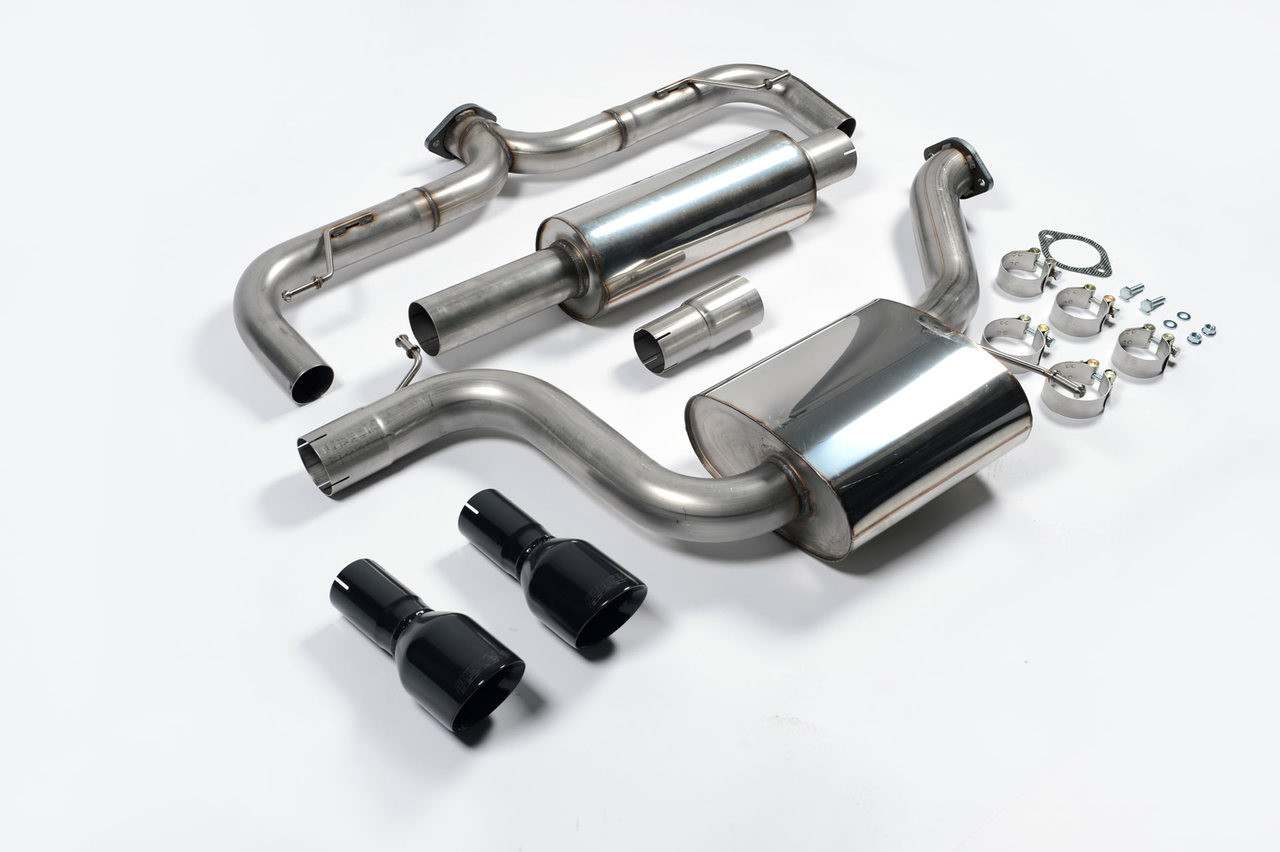
We stock exhaust systems across the range, from a straightforward decat through to a full cat-back system. Pricing reflects how much of the system you're replacing, and which brand is doing the work. These are the three Golf GTI exhaust options our customers ask for most:
| Product | Price | Best suited to |
|---|---|---|
| Scorpion Downpipe and Cat/Decat (Mk7/7.5 GTI, Non-GPF) | £374.50 to £696.46 | Adds more flow and a sharper note to pre-GPF cars, without the cost of a full system |
| Scorpion Cat Back Exhaust System (Mk7 GTI) | £793.04 to £1,002.20 | A fuller, louder system that keeps the factory cat in place |
| Milltek Cat-Back Exhaust (Mk7 GTI/Clubsport) | £1,115.65 to £1,408.15 | The deepest note in the range, from a well-known big-name brand |
If you're planning a remap alongside it, the downpipe and decat option above doubles as the supporting hardware a Stage 2 map needs. It's worth reading the remap section below before you commit to a spec.

Remaps and ECU Tuning: Software First, Hardware When You Need It
A remap is usually the cheapest way to get a meaningful jump in power, and it's where most owners start their VW Golf GTI performance upgrades first.
Getting the Sound Right
Start by deciding how much extra volume you want. A resonated system usually keeps the note more restrained and helps reduce drone, while a non-resonated system gives the exhaust more presence.
On a pre-GPF car, a cat-back system replaces the exhaust after the catalytic converter and keeps the original emissions equipment in place. A downpipe sits closer to the turbo and may use a sports catalyst or no catalyst at all. A decat removes the catalytic converter, so it isn’t legal for road use.
Later GTIs fitted with a petrol particulate filter need parts designed for that exhaust layout. A GPF-back system replaces the section after the filter, leaving the GPF in place. Compatible downpipes are also available for some cars, but the required hardware and software depend on the exact model.
Staying Road Legal
The DVSA MOT inspection manual classifies an exhaust that’s unreasonably louder than a similar car with a standard silencer as a major defect. Factory emissions equipment must also be present and unmodified. This rules out a decat on a road car, even if the rest of the system is secure and well fitted.
Choose a system approved for road use and make sure every part is fitted correctly. You’ll also need to tell your insurer about the modification, preferably before it’s installed. Exhaust changes can affect cover, and the exact requirements depend on your policy.
Our Exhaust Range at a Glance
We stock exhaust systems across the range, from a straightforward decat through to a full cat-back system. Pricing reflects how much of the system you're replacing, and which brand is doing the work. These are the three Golf GTI exhaust options our customers ask for most:
| Product | Price | Best suited to |
|---|---|---|
| Scorpion Downpipe and Cat/Decat (Mk7/7.5 GTI, Non-GPF) | £374.50 to £696.46 | Adds more flow and a sharper note to pre-GPF cars, without the cost of a full system |
| Scorpion Cat Back Exhaust System (Mk7 GTI) | £793.04 to £1,002.20 | A fuller, louder system that keeps the factory cat in place |
| Milltek Cat-Back Exhaust (Mk7 GTI/Clubsport) | £1,115.65 to £1,408.15 | The deepest note in the range, from a well-known big-name brand |
If you're planning a remap alongside it, the downpipe and decat option above doubles as the supporting hardware a Stage 2 map needs. It's worth reading the remap section below before you commit to a spec.
Remaps and ECU Tuning: Software First, Hardware When You Need It
A remap is usually the cheapest way to get a meaningful jump in power, and it's where most owners start their VW Golf GTI performance upgrades first.
Software First: What a Stage 1 Remap Delivers
The Mk7 and Mk7.5 GTI both use the 2.0 TSI EA888 Gen 3 engine, but the factory output depends on the version. The Mk7 was available with 220 PS or 230 PS, while the Mk7.5 offered 230 PS or 245 PS.
Most Stage 1 calibrations for these cars are designed to work with the standard intake and exhaust. The final output depends on the car’s original specification and the software fitted. Fuel grade can affect the quoted figure too, so check the figures supplied for the specific map.
For owners who want more power without changing the hardware first, Stage 1 is a sensible place to begin.
Hardware When You Need It: Modules vs a Full Remap
A plug-in tuning module connects to the engine sensors and adjusts the signals sent to the ECU. It can be removed without reflashing the car, which suits owners looking for a reversible upgrade.
A full remap changes the calibration stored inside the ECU and gives the tuner control over a wider set of engine settings. It isn’t permanent, as the ECU can usually be flashed back to its standard calibration.
A tuning module isn’t automatically the cheaper option. Compare the price and expected output of the specific products available for your GTI before deciding which route suits your plans.
Our Remap Range at a Glance
Our remap range runs from an entry-level plug-in module up to a full Stage 2 software remap. Either way, fitting happens at our Manchester workshop, along with a rolling road session (a dyno run that measures the actual power reaching the wheels). These three cover most of what we're asked about:
| Product/service | Price | Best suited to |
|---|---|---|
| RaceChip plug-in tuning module | from £139 | A reversible first step, or a stopgap before a full remap |
| APR Stage 1 Remap (Mk7/Mk7.5 GTI), 2.0 TSI EA888 245PS OPF/GPF | £555.50 | The most common first remap on a Mk7/Mk7.5 GPF-equipped GTI, no hardware changes needed |
| RacingLine Software Stage 2 Remap, 2.0 TSI EA888 Gen.4 245PS (Mk8 GTI) | £720.00 to £918.00 | Owners who've already fitted the supporting hardware and want the extra step up |
Every remap carried out at our Manchester workshop includes before-and-after power runs on our in-house Dynojet rolling road. You’ll see what the car produced before the software was installed and how it performs with the new calibration, rather than relying on quoted figures alone.
How Intake and Cooling Support a Remapped Engine
Once you've stepped past Stage 1, the standard intake and cooling system becomes the next limit. The sports cat and remap can now ask for more air than the factory intake supplies to the turbo. An upgraded intake, and on some builds a better intercooler, is what lets the rest of the hardware do its job instead of holding it back.
Choosing Between the Two Options
We stock intake systems at two clear points on the Mk8 GTI. One is built for straightforward gains and includes secondary air injection (SAI) hardware, part of the emissions system. The other is built as much for the engine bay as the numbers:
| Product | Price | Best suited to |
|---|---|---|
| CTS Turbo Intake System (Mk8 Golf GTI/8Y A3 EVO4, with SAI) | £304.49 | A cost-effective flow increase to support a Stage 2 remap |
| RacingLine R600 EVO Intake System (MQB-Evo models) | £424.57–£463.88, depending on filter choice | Owners wanting a high-capacity enclosed airbox with a factory-style finish |
| Eventuri Carbon Fibre Intake System (Mk8 Golf GTI, Cupra, Formentor 245) | £1,399.20 | Adds a fully enclosed carbon airbox alongside the performance gain |
Both are built around the factory turbo and airbox location, so fitting one doesn't mean altering anything else about the car. Either pairs well with the remaps covered above. The choice mostly comes down to budget, and how much you want the engine bay itself to be part of the upgrade
Brakes: Stopping Power to Match Any Power Increase
More power is only half the job done if the brakes are still standard. It's a section a lot of buyers skip until something reminds them why they shouldn't.
When Pads Alone Are Enough
If you're only replacing pads that have worn down, like for like, the standard parts do exactly what they're meant to do. The moment you want the car to pull up harder, especially after a remap, that calls for a different pad compound or a different disc, sometimes both.
Stepping Up to a Big Brake Kit
An upgraded pad is the simplest step, and a bigger disc and caliper setup is the biggest. There's a sensible middle ground between the two, set out below:
| Product | Price | Best suited to |
|---|---|---|
| Ferodo DS Performance Front Brake Pads (Golf GTI/GTD Mk7) | £209.01 | A straightforward pad upgrade on standard discs and calipers |
| Tarox Strada Front Brake Pads (Golf Mk7) | £143.00 to £147.00 | A track-friendly pad that doesn't need any other hardware changed |
| Tarox Front Big Brake Kit (Golf Mk7, 345x30mm) | £2,430.00 | Cars carrying real extra power that need bigger discs and calipers to match |
A big brake kit is also where wheel clearance from earlier in this guide actually bites. Check your wheel's inner diameter against the kit's caliper dimensions before you order, not after it turns up.
Suspension and Lowering: Why DCC Comes First
Check whether your GTI has Dynamic Chassis Control before comparing suspension kits. DCC uses electronically controlled dampers, so replacing them with conventional coilovers removes the factory adjustment and can trigger a fault. You’ll need a suitable cancellation kit if you choose this route.
To retain the electronic damping control, choose coilovers designed to integrate with DCC. Compatible lowering springs also keep the system working because the original dampers remain in place. Check the manufacturer’s fitment guidance for your exact GTI before ordering.
DCC and Non-DCC Options Compared
Our suspension range covers both DCC and non-DCC cars, from a springs-only lowering kit up to a full DCC-retaining coilover setup:
| Product | Price | Best suited to |
|---|---|---|
| APR Roll-Control Lowering Springs (Mk8 Golf GTI, DCC and non-DCC) | £305.44 | A visual and ride-height drop that works on both DCC and non-DCC dampers |
| ST Suspension ST X Coilovers (Golf Mk7 hatchback inc. GTI & R) | £747.00 | Adjustable height and damping in one kit, for non-DCC cars |
| Bilstein B12 Pro-Kit (VW Golf Mk7 GTI) | £971.04 | Non-DCC cars wanting a more road-focused ride than a full coilover |
| KW DDC Plug & Play Coilovers (Golf 8 with DCC) | £2,558.00 | Mk8 cars with DCC that want a coilover without losing the factory electronics |
Whichever route you take, settle the DCC question above before you order, since it decides which of these four you can actually fit.
Not Sure If You Have DCC?
If you're on a Mk8, our Mk8 shop-by-car page lists every suspension option we stock for DCC and non-DCC cars side by side. Not sure whether your car has DCC? Our team can check it against your registration before you order anything.
Styling and Aero Round Off the Build
Styling comes last in this guide because the mechanical setup usually decides what will fit best. A front splitter or body kit changes the car’s appearance, and some parts are also designed to influence airflow around the body. You can start with styling if that’s your priority, but consider the finished ride height before fitting a splitter. Rear styling parts also need to suit the bumper and exhaust layout.
Our Styling Picks
Our three most popular styling parts for the GTI sit at very different price points, running from a simple bolt-on up to a full carbon piece:
| Product | Price | Best suited to |
|---|---|---|
| Maxton Design Front Racing Splitter V.2 (Golf GTI 7.5, 2017-19) | £149.00 | A visible front-end change on a budget |
| ECS Tuning Gloss Black Rear Diffuser (Mk7 Golf GTI) | £366.26 | A finished rear end that pairs well with a cat-back exhaust |
| APR Carbon Fibre Rear Diffuser (Golf Mk8 GTI) | £1,184.99 | A carbon fibre finish for Mk8 owners who'd rather skip ABS plastic |
Fit any of these alongside the exhaust changes from earlier in the guide. The back of the car then reads as one finished job rather than a collection of separate mods.
Choosing the Right VW Golf GTI Parts: A Sensible Build Order
Each category above can be tackled on its own, so you don’t need to follow this guide in order. If you’re planning several VW Golf GTI upgrades, the order below will help you decide what to fit first.
Step One: Choose Your Power Upgrade
If more power is the priority, start with the tuning route. A RaceChip tuning module is a removable plug-in unit. APR and RacingLine software changes the ECU calibration itself.
Most Stage 1 calibrations are designed to work with standard hardware, although fuel grade and vehicle requirements vary. Check the software available for your exact GTI before booking. Stage 2 belongs in the next step because its specified hardware needs to be fitted first.
Step Two: Fit the Hardware Required for Stage 2
If Stage 2 is the plan, choose the software first and follow its hardware requirements. These vary between GTI generations and calibrations. A high-flow Scorpion downpipe is a common requirement on some setups, while others also call for better cooling.
For a UK road car, choose a sports catalyst that retains the required emissions equipment. A decat removes the catalyst and will fail the MOT inspection if required emissions equipment is missing or obviously modified, as set out in the DVSA MOT inspection manual.
A cat-back system from Scorpion or Milltek is mainly chosen for sound and isn’t normally required for Stage 2. Intakes from CTS Turbo and Eventuri reduce intake restriction and add induction sound, but they aren’t required by every calibration.
Extra torque can make a worn or marginal standard clutch slip on a manual GTI. Check its condition and torque capacity when choosing the map. For Mk7 and Mk7.5 GTI owners planning Stage 1, our Stage 1 ECU remap and performance clutch package brings the software and clutch upgrade together.
Choose APR or RacingLine software, paired with a Sachs Performance organic clutch. The package includes a release bearing, clutch installation and geometry alignment at our Manchester workshop. A replacement flywheel is extra, and the included clutch isn’t suitable for Stage 2, so speak to us about the right Sachs Performance clutch upgrade if you’re planning further tuning.
Step Three: Plan the Brakes Around How You Drive
A remap doesn’t automatically require a brake conversion, but the braking setup should be considered alongside any increase in performance. For a road-driven GTI, suitable pads from Ferodo or Tarox may be enough if the discs, calipers and fluid are in good condition. Check that the pad compound suits road use before ordering.
A Tarox front big brake kit adds larger discs and calipers for greater heat capacity. It makes sense when repeated hard stops or track use are pushing the standard brakes beyond what they were designed to handle.
Step Four: Choose Suspension to Suit the Car
Suspension can be planned separately from engine tuning, but DCC changes which parts will fit. On a non-DCC Mk7 or Mk7.5 GTI, ST X coilovers provide adjustable ride height. The Bilstein B12 Pro-Kit uses matched Bilstein dampers and Eibach springs at a fixed ride height.
APR Roll-Control lowering springs work with both DCC and non-DCC factory dampers. If you want to replace the adaptive dampers with coilovers and retain the factory controls, the KW DDC Plug & Play kit is designed for that job. Check the generation, axle weight and damper setup before ordering.
Step Five: Finish With Styling
Styling usually comes after the suspension and exhaust because ride height, bumper design and tailpipe position can affect the final fit. Maxton Design offers front splitters for several GTI generations, while ECS Tuning diffusers need to be matched to the correct bumper. The APR carbon-fibre rear diffuser is made specifically for the Mk8 GTI.
Unless the manufacturer provides aerodynamic testing data, these parts are better treated as styling upgrades. They can still come first if changing the car’s appearance is your current priority.
We've been fitting and tuning VW Golf GTIs from our Manchester workshop for over 35 years. Every remap and clutch package we sell comes with a free rolling road run, so you can see exactly what your car's making before you drive it home. If you're not sure where to start, or you want a second opinion on a build before you commit to it, get in touch with our team. We'll talk it through properly, no sales script involved.